Free Fannie Mae Variable Rate Non-Cum. Pfd. Series P (FNMAH) Technical Analysis Signals
Fannie Mae Variable Rate Non-Cum. Pfd. Series P (FNMAH) signal with technical analysis on 23 Jul
KAMA 1KAMA 2KAMA 3KAMA 4TEMA Price 2TEMA Price 3TRIMA Slope 1TRIMA Slope 2TRIMA Slope 3PLUS_DI Threshold 1PLUS_DI Threshold 2BOP Smoothed ThresholdMACD Crossover 1Volume SpikeADXR with DI+/DI-
Doji High-Wave Candle Long Legged Doji Spinning Top
Overall Strategy:
Buy Signals: 4
Sell Signals: 11
Neutral Signals: 84
Result: This strategy leads to a Sell position.
Disclaimer! Please exercise caution and thorough consideration before making any financial decisions. It's important to note that our signals are based solely on daily price changes and do not take into account external factors such as news, market sentiment, or company developments. We strongly recommend considering all relevant factors and conducting your own research.
Useful Tips: To make the most informed decisions about your Fannie Mae Variable Rate Non-Cum. Pfd. Series P (FNMAH) investments, we highly recommend visiting the "Magic Prediction" AI models signals website. They provide free signals, and if one aligns with ours, it is likely to be a reliable indicator, as we have observed over time.
Result: Looking at the technical analysis for Fannie Mae Variable Rate Non-Cum. Pfd. Series P (FNMAH) on , there is a tendency towards a sell signal based on historical data and analysis. However, it’s crucial to remember that these signals are not guarantees. Make sure to carefully consider overall market conditions and align your decisions with your specific investment goals.
Based on the above signals and forecasts, we recommend the following strategies:
Fannie Mae Variable Rate Non-Cum. Pfd. Series P (FNMAH) trading strategy for those in buy positions (long positions): If you are currently in a buy (long) position, it is advisable to identify the optimal time to exit your position based on a combination of technical signals. Those with a high risk tolerance may choose to wait and observe market movements over the next few days.
Fannie Mae Variable Rate Non-Cum. Pfd. Series P (FNMAH) trading strategy for those in sell positions (short positions): If you are in a sell (short) position, holding your position may be the right strategy, as indicated by the consensus of our technical analysis. However, be cautious and monitor market developments closely.
For new positions: If you are not currently invested or considering switching to a sell (short) position, it’s recommended to assess the potential downside of INF% based on the lowest expected price range. Ensure that this aligns with your risk tolerance and objectives by conducting thorough research before entering a short position.
In all trading scenarios, a well-defined stop-loss strategy is critical to managing potential downside risks effectively.
Useful Tip: For long-term forecasting, we recommend using the "Predict-price" website, which offers both short-term and long-term predictions at no cost. This resource can support informed decision-making regarding your **Fannie Mae Variable Rate Non-Cum. Pfd. Series P (FNMAH)** investments.
Fannie Mae Variable Rate Non-Cum. Pfd. Series P (FNMAH) Price Analysis and Support Levels:
In our current Fannie Mae Variable Rate Non-Cum. Pfd. Series P (FNMAH) position, we find ourselves in a short position, anticipating a potential downward trend. Understanding the key support levels is essential, as these serve as critical reference points for traders and investors to make informed decisions.First Support Level: 0
We are closely monitoring the price at 0, the first support level. If the downward trend continues, breaching this level would signal strong selling pressure, suggesting the possibility of further price depreciation.
These support levels should be carefully considered within the context of broader market trends and indicators. By staying alert and consistently analyzing the market, you can make well-informed decisions while trading Fannie Mae Variable Rate Non-Cum. Pfd. Series P (FNMAH). Keeping these support levels in mind will help you adapt to the dynamic nature of the market and make smarter trading choices.
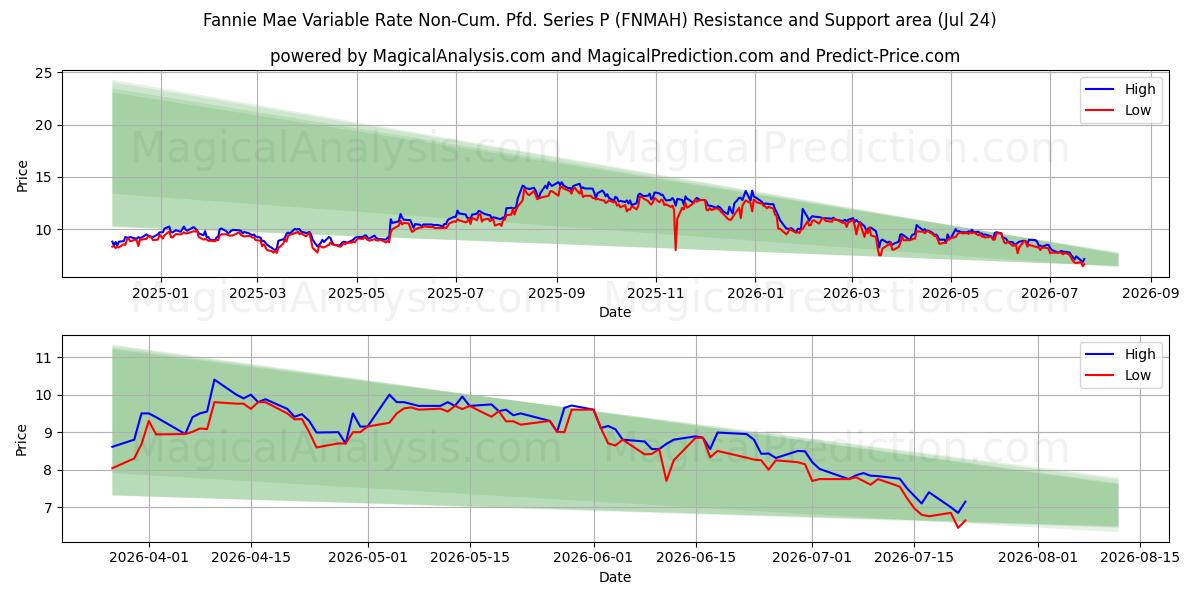
Fannie Mae Variable Rate Non-Cum. Pfd. Series P (FNMAH) technical analysis chart
Fannie Mae Variable Rate Non-Cum. Pfd. Series P (FNMAH) support and resistance levels
| Name | Level1 | Level2 | Level3 | Level4 | Level5 |
|---|---|---|---|---|---|
| Resistance | 7.5 | 7.77 | 10.07 | 14.5 | -- |
| Support | -- | -- | -- | -- | -- |
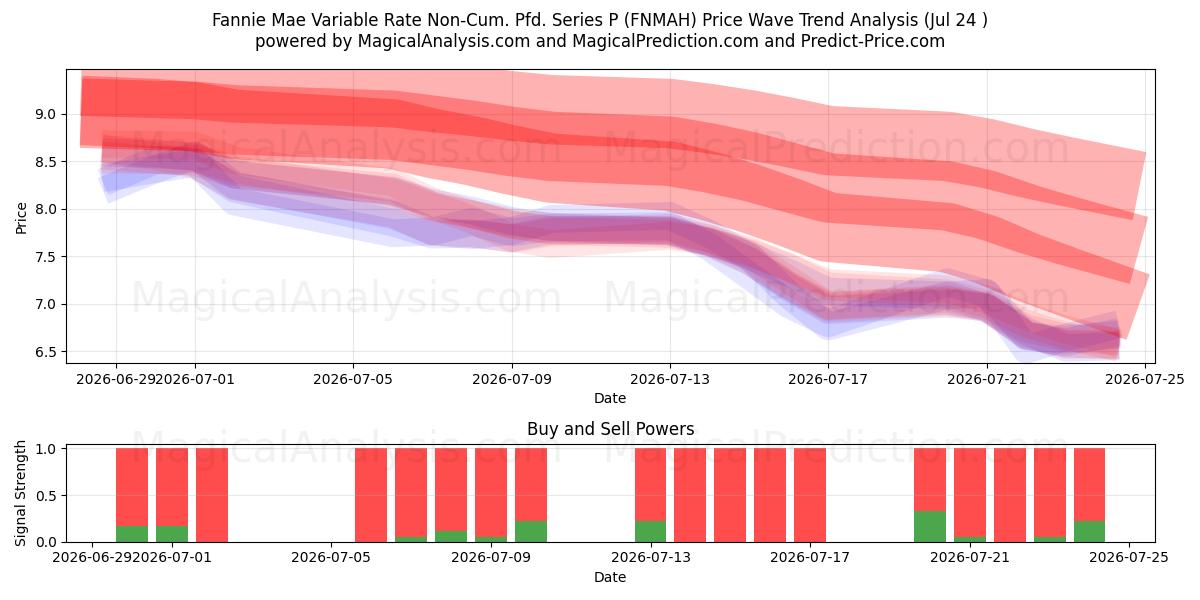
Fannie Mae Variable Rate Non-Cum. Pfd. Series P (FNMAH) signals list for 23 Jul
| Overall Signals |
|---|
Fannie Mae Variable Rate Non-Cum. Pfd. Series P (FNMAH) candlestick patterns on 23 Jul
Fannie Mae Variable Rate Non-Cum. Pfd. Series P (FNMAH) technical analysis over the past days
| # | Date | Overal Signals | ALL Signals |
|---|---|---|---|
| 1 | 23 Jul | S | KAMA 1KAMA 2KAMA 3KAMA 4MIDPOINT Slope 4TRIMA Slope 1TRIMA Slope 2TRIMA Slope 3CCI Crossover 1CCI Crossover 3PLUS_DI Threshold 1PLUS_DI Threshold 2RSI Exit OversoldRSI Exit OverboughtBOP Smoothed ThresholdSTOCH Normal Zone CrossBBANDS Breakout 2ADXR with DI+/DI- |
| 2 | 22 Jul | S | DEMA 1DEMA 2DEMA 3KAMA 1KAMA 2KAMA 3KAMA 4WMA Crossover 1MIDPOINT Slope 2MIDPOINT Slope 4TEMA Price 1TEMA Price 2TEMA Price 3TRIMA Slope 2TRIMA Slope 3CMO Crossover 1PLUS_DI Threshold 1PLUS_DI Threshold 2WILLR Exit OversoldBOP Smoothed ThresholdMoney Flow IndexChaikin AD CrossoverChaikin ADOSC Zero CrossDEMA with ATR 2DEMA with ATR 3Volume SpikeADXR with DI+/DI-Donchian ChannelCMO Divergence 1 |
| 3 | 21 Jul | S | EMA Price Cross 4KAMA 2KAMA 3KAMA 4WMA Crossover 1TRIMA Slope 1TRIMA Slope 2TRIMA Slope 3PLUS_DI Threshold 1PLUS_DI Threshold 2WILLR Exit OverboughtBOP Smoothed ThresholdStochastic RSI SignalChaikin AD CrossoverChaikin ADOSC Zero CrossADXR with DI+/DI-Keltner Channel 1Elder's Force Index |
| 4 | 20 Jul | S | DEMA 1DEMA 2EMA Price Cross 4KAMA 3KAMA 4TEMA Price 1TEMA Price 2TEMA Price 3TRIMA Slope 1TRIMA Slope 2TRIMA Slope 3CCI Crossover 3PLUS_DI Threshold 1PLUS_DI Threshold 2RSI Exit OversoldRSI Exit OverboughtBOP Smoothed ThresholdBBANDS Breakout 2Stochastic RSI SignalMoney Flow IndexADXR with DI+/DI-Daily Pivot Point 1Elder's Force IndexCMO Divergence 1CMO Divergence 2 |
| 5 | 17 Jul | B | DEMA 2DEMA 3KAMA 1KAMA 2KAMA 3KAMA 4MIDPOINT Slope 1MIDPOINT Slope 3MIDPOINT Slope 4T3 Slope 1TEMA Price 2TEMA Price 3TRIMA Slope 1TRIMA Slope 2TRIMA Slope 3CMO Crossover 2PLUS_DI Threshold 1PLUS_DI Threshold 2BOP Smoothed ThresholdChaikin AD CrossoverChaikin ADOSC Zero CrossDEMA with ATR 2DEMA with ATR 3Volume SpikeADXR with DI+/DI-Donchian ChannelDaily Pivot Point 1CMO Divergence 1 |
| 6 | 16 Jul | S | DEMA 1DEMA 2DEMA 3KAMA 1KAMA 2KAMA 3KAMA 4MIDPOINT Slope 1MIDPOINT Slope 2MIDPOINT Slope 3MIDPOINT Slope 4TEMA Price 2TEMA Price 3TRIMA Slope 1TRIMA Slope 2TRIMA Slope 3PLUS_DI Threshold 1PLUS_DI Threshold 2BOP Smoothed ThresholdADXR with DI+/DI-Donchian ChannelDaily Pivot Point 1CMO Divergence 1 |
| 7 | 15 Jul | S | DEMA 1DEMA 2DEMA 3KAMA 1KAMA 2KAMA 3KAMA 4MIDPOINT Slope 1MIDPOINT Slope 3MIDPOINT Slope 4TEMA Price 2TEMA Price 3TRIMA Slope 1TRIMA Slope 2TRIMA Slope 3CMO Crossover 1PLUS_DI Threshold 1PLUS_DI Threshold 2BOP Smoothed ThresholdSTOCH Normal Zone CrossDEMA with ATR 3Volume SpikeADXR with DI+/DI-Donchian ChannelDaily Pivot Point 1CMO Divergence 1 |
| 8 | 14 Jul | S | DEMA 3KAMA 1KAMA 2KAMA 3KAMA 4WMA Crossover 1TRIMA Slope 2TRIMA Slope 3PLUS_DI Threshold 1PLUS_DI Threshold 2ROCR Threshold 1WILLR Exit OversoldBOP Smoothed ThresholdMACD Crossover 1Stochastic RSI SignalADXR with DI+/DI-Keltner Channel 1Donchian ChannelElder's Force IndexCMO Divergence 1 |
| 9 | 13 Jul | S | KAMA 2KAMA 3KAMA 4TEMA Price 2TEMA Price 3TRIMA Slope 2TRIMA Slope 3CCI Crossover 2PLUS_DI Threshold 1PLUS_DI Threshold 2BOP Smoothed ThresholdMACD Crossover 1Hammer / Hanging ManVolume SpikeADXR with DI+/DI- |
| 10 | 10 Jul | S | DEMA 1KAMA 2KAMA 3KAMA 4WMA Crossover 1T3 Slope 2TEMA Price 2TEMA Price 3TRIMA Slope 2TRIMA Slope 3CCI Crossover 1PLUS_DI Threshold 1PLUS_DI Threshold 2RSI Exit OversoldBOP Smoothed ThresholdChaikin AD CrossoverEngulfing PatternVolume SpikeADXR with DI+/DI-Daily Pivot Point 1Elder's Force IndexCMO Divergence 1 |
| 11 | 09 Jul | B | DEMA 3KAMA 1KAMA 2KAMA 3KAMA 4MIDPOINT Slope 2MIDPOINT Slope 3T3 Slope 2TRIMA Slope 1TRIMA Slope 2TRIMA Slope 3AROONOSC 1AROONOSC 3PLUS_DI Threshold 1PLUS_DI Threshold 2BOP Smoothed ThresholdChaikin AD CrossoverVolume SpikeADXR with DI+/DI-CMO Divergence 1 |
| 12 | 08 Jul | S | KAMA 2KAMA 3KAMA 4T3 Slope 2TRIMA Slope 1TRIMA Slope 2TRIMA Slope 3CCI Crossover 3PLUS_DI Threshold 1PLUS_DI Threshold 2BOP Smoothed ThresholdBBANDS Breakout 2Stochastic RSI SignalADXR with DI+/DI-CMO Divergence 2 |
| 13 | 07 Jul | S | DEMA 3KAMA 1KAMA 2KAMA 3KAMA 4MIDPOINT Slope 1T3 Slope 1T3 Slope 2TEMA Price 3TRIMA Slope 1TRIMA Slope 2TRIMA Slope 3PLUS_DI Threshold 1PLUS_DI Threshold 2BOP Smoothed ThresholdPercentage Price OscillatorADXR with DI+/DI-CMO Divergence 1 |
| 14 | 06 Jul | S | DEMA 1DEMA 2DEMA 3KAMA 1KAMA 2KAMA 3KAMA 4MIDPOINT Slope 1MIDPOINT Slope 2MIDPOINT Slope 3MIDPOINT Slope 4T3 Slope 1T3 Slope 2TEMA Price 2TEMA Price 3TRIMA Slope 1TRIMA Slope 2PLUS_DI Threshold 1PLUS_DI Threshold 2WILLR Exit OversoldWILLR Exit OverboughtBOP Smoothed ThresholdMoney Flow IndexADXR with DI+/DI-Keltner Channel 1Elder's Force IndexCMO Divergence 1 |
| 15 | 02 Jul | S | DEMA 1DEMA 2DEMA 3EMA Price Cross 4KAMA 1KAMA 2KAMA 3KAMA 4WMA Crossover 1MIDPOINT Slope 1MIDPOINT Slope 2MIDPOINT Slope 3MIDPOINT Slope 4T3 Slope 1T3 Slope 2TEMA Price 1TEMA Price 2TEMA Price 3TRIMA Slope 2SAR CrossoverAROONOSC 2AROONOSC 4PLUS_DI Threshold 1PLUS_DI Threshold 2ROC Threshold 2ROCR Threshold 3TRIX Crossover 1BOP Smoothed ThresholdMACD Crossover 1STOCH Normal Zone CrossStochastic RSI SignalUltimate OscillatorADXR with DI+/DI-Rolling VWAPCMO Divergence 1 |
| 16 | 01 Jul | S | KAMA 2KAMA 3KAMA 4WMA Crossover 1MIDPOINT Slope 2MIDPOINT Slope 4T3 Slope 2TEMA Price 3TRIMA Slope 2MOM Crossover 2PLUS_DI Threshold 1PLUS_DI Threshold 2BOP Smoothed ThresholdMACD Crossover 1STOCH Normal Zone CrossVolume SpikeADXR with DI+/DI- |
| 17 | 30 Jun | S | EMA Price Cross 4KAMA 2KAMA 3KAMA 4MIDPOINT Slope 2T3 Slope 1TEMA Price 1TEMA Price 2TEMA Price 3TRIMA Slope 1TRIMA Slope 2CCI Crossover 1CCI Crossover 2MOM Crossover 2PLUS_DI Threshold 1PLUS_DI Threshold 2ROCR Threshold 3BOP Smoothed ThresholdStochastic RSI SignalMoney Flow IndexADXR with DI+/DI-Daily Pivot Point 1Rolling VWAP |
| 18 | 29 Jun | N | KAMA 2KAMA 3KAMA 4MIDPOINT Slope 1MIDPOINT Slope 2T3 Slope 1TEMA Price 3TRIMA Slope 1AROONOSC 2CCI Crossover 3PLUS_DI Threshold 1PLUS_DI Threshold 2BOP Smoothed ThresholdADXR with DI+/DI-CMO Divergence 1 |
| 19 | 26 Jun | S | DEMA 3KAMA 2KAMA 3KAMA 4MIDPOINT Slope 1T3 Slope 1TEMA Price 2TEMA Price 3TRIMA Slope 1AROONOSC 3PLUS_DI Threshold 1PLUS_DI Threshold 2BOP Smoothed ThresholdADXR with DI+/DI-CMO Divergence 1 |
| 20 | 25 Jun | S | DEMA 1DEMA 2DEMA 3EMA Price Cross 1EMA Price Cross 2EMA Price Cross 3EMA Price Cross 4KAMA 1KAMA 4EMA Crossover 1WMA Crossover 1MIDPOINT Slope 1TEMA Price 1TEMA Price 2TEMA Price 3SAR CrossoverAROONOSC 1AROONOSC 3MOM Crossover 1ROC Threshold 1ROCR Threshold 1ROCR Threshold 2TRIX Crossover 1WILLR Exit OversoldBOP Smoothed ThresholdMACD Crossover 2BBANDS Breakout 1Ichimoku 2CMO Divergence 1 |
| 21 | 18 Jun | B | DEMA 1EMA Price Cross 1EMA Price Cross 2EMA Price Cross 4KAMA 1KAMA 2KAMA 3KAMA 4EMA Crossover 1WMA Crossover 1MIDPOINT Slope 1TEMA Price 1TEMA Price 2TRIMA Slope 1TRIMA Slope 3PLUS_DI Threshold 1PLUS_DI Threshold 2ROC Threshold 2BOP Smoothed ThresholdStochastic RSI SignalMoney Flow IndexHammer / Hanging ManIchimoku 2Ichimoku 3CMO Divergence 1 |
| 22 | 17 Jun | S | KAMA 3KAMA 4MIDPOINT Slope 1MIDPOINT Slope 4TEMA Price 2TEMA Price 3TRIMA Slope 1TRIMA Slope 3PLUS_DI Threshold 1BOP Smoothed ThresholdCMO Divergence 1 |
| 23 | 16 Jun | N | DEMA 2EMA Price Cross 2KAMA 3KAMA 4EMA Crossover 1WMA Crossover 2MIDPOINT Slope 3TEMA Price 2TEMA Price 3TRIMA Slope 1TRIMA Slope 2TRIMA Slope 3PLUS_DI Threshold 1ROCR Threshold 1BOP Smoothed ThresholdIchimoku 2CMO Divergence 1CMO Divergence 2 |
| 24 | 15 Jun | N | DEMA 1DEMA 2EMA Price Cross 1EMA Price Cross 4KAMA 3KAMA 4WMA Crossover 1TEMA Price 1TEMA Price 2TEMA Price 3TRIMA Slope 2TRIMA Slope 3CCI Crossover 1CCI Crossover 2CCI Crossover 3PLUS_DI Threshold 1PLUS_DI Threshold 2BOP Smoothed ThresholdMACD Crossover 1CMO Divergence 1CMO Divergence 2 |
| 25 | 12 Jun | B | KAMA 1KAMA 2KAMA 3KAMA 4T3 Slope 2TRIMA Slope 2TRIMA Slope 3AROONOSC 4PLUS_DI Threshold 1PLUS_DI Threshold 2BOP Smoothed ThresholdChaikin AD Crossover |
| 26 | 11 Jun | S | KAMA 2KAMA 3KAMA 4T3 Slope 2TRIMA Slope 1TRIMA Slope 2CCI Crossover 3Chaikin AD Crossover |
| 27 | 10 Jun | S | DEMA 3KAMA 2KAMA 3KAMA 4T3 Slope 1T3 Slope 2TEMA Price 3TRIMA Slope 1TRIMA Slope 2RSI Exit OversoldBBANDS Breakout 2Stochastic RSI Signal |
| 28 | 09 Jun | S | DEMA 2DEMA 3KAMA 1KAMA 2KAMA 3KAMA 4MIDPOINT Slope 1MIDPOINT Slope 2MIDPOINT Slope 3MIDPOINT Slope 4T3 Slope 1T3 Slope 2TEMA Price 2TEMA Price 3TRIMA Slope 1TRIMA Slope 2BOP Smoothed ThresholdKeltner Channel 1Donchian ChannelCMO Divergence 1 |
| 29 | 08 Jun | S | DEMA 3KAMA 2KAMA 3KAMA 4T3 Slope 1T3 Slope 2TEMA Price 3TRIMA Slope 1PLUS_DI Threshold 2RSI Exit OversoldBOP Smoothed ThresholdBBANDS Breakout 2Stochastic RSI Signal |
| 30 | 05 Jun | S | DEMA 1DEMA 2DEMA 3KAMA 1KAMA 2KAMA 3KAMA 4MIDPOINT Slope 1MIDPOINT Slope 2MIDPOINT Slope 3MIDPOINT Slope 4T3 Slope 1T3 Slope 2TEMA Price 2TEMA Price 3TRIMA Slope 1AROONOSC 3PLUS_DI Threshold 2ROCR Threshold 1WILLR Exit OversoldWILLR Exit OverboughtBOP Smoothed ThresholdEngulfing PatternKeltner Channel 1Donchian ChannelDaily Pivot Point 1CMO Divergence 1 |
Users forecasts for Fannie Mae Variable Rate Non-Cum. Pfd. Series P (FNMAH)
What is your prediction?
In this section, you can easily predict without user registration. See also other users predictions.
